
To beat a pickleball player who never seems to miss, stop forcing winners. Move them, change their contact point, vary pace and direction, and wait for the easier ball. The goal isn’t to make them miss immediately—it’s to make their next shot worse.
You know this player. Nothing about their game looks terrifying. The serve isn’t huge. The speedup isn’t outrageous. They’re not Erne-ing every third point.
You hit a good dink.
Back it comes.
You move them.
Back it comes.
You finally decide you’ve had enough, rip a ball six inches from the sideline…and miss.
They haven’t really beaten you. They’ve convinced you to beat yourself.
That’s the trap with ultra-consistent pickleball players. After enough balls come back, you start believing your next shot needs to be better than it actually does.
Harder.
Sharper.
Closer to the line.
More ambitious.
Usually, that’s exactly what the consistent player is waiting for. So forget trying to “out-consistent” the human wall. And don’t try to blast through them, either.
There’s a smarter objective: don’t try to make them miss this ball. Make their next ball worse.
That’s how you crack a player who seems to return everything.
First, understand what they’re actually good at
“Never misses” is not a skill. It’s an outcome. The useful question is why they rarely miss.
Some players are fantastic blockers. Give them pace and they’ll redirect it all afternoon. Some can dink crosscourt for a week but become uncomfortable when they have to move laterally and recover.
Some are excellent when their feet are planted.
Some defend brilliantly but don’t do much with a neutral ball.
Some have wonderfully boring backhands and dangerous forehands.
And some really are just annoyingly good.
Before changing your game, spend several rallies identifying which version you’re facing. A simple way to think about it:
| The “wall” likes… | Test them with… |
|---|---|
| Your pace | Softer balls and changes of speed |
| Crosscourt rhythm | Middle and straight-ahead balls |
| Standing still | Controlled movement before the attack |
| Forehand contacts | Backhand hip/inside foot |
| Comfortable bounce dinks | Balls around the feet that make volley-vs-bounce decisions awkward |
| Defending hard attacks | Patient pressure instead of another harder attack |
You’re not searching for a magical weakness. You’re looking for the ball they return with the least quality.
A great defender may still return 19 out of 20 balls. But if six of those returns float slightly higher, land slightly shorter or arrive with less pressure, you’ve found something useful.
Stop trying to win with the first good ball
This is probably the biggest adjustment. Intermediate players see a mildly attackable ball and think: There it is.
Then they try to finish the point.
Against a good defender, that often produces one of two things:
They counter it.
Or you overhit it.
Instead, treat the first good ball as a setup ball. Imagine a dink pulls your opponent half a step wide. You don’t necessarily need to rip the next ball past them.
Maybe you simply redirect it toward the space they’re recovering from.
Now they have to stop, change direction and make another contact. That reply may be the ball you attack.
This is point construction rather than winner hunting.
And elite pickleball increasingly looks like this. A 2025 analysis tracked 6,839 shots from eight professional men’s doubles matches and found that 60.5% of rallies contained between three and 10 shots. Crosscourt play accounted for 54% of trajectories.
A separate 2026 analysis found rallies of 13 shots or more were actually the most common category in its sample of elite men’s doubles.
Good players aren’t surprised when another ball comes back.
You shouldn’t be either.
Think:
Ball one creates discomfort.
Ball two exploits the recovery.
Ball three may finally be attackable.
Sometimes it happens faster. Sometimes it takes eight shots.
The principle is the same.
Don’t attack the player. Attack the contact point.
This is where the strategy gets much more precise.
A balanced opponent contacting the ball comfortably in front of the body is difficult to bother. So stop giving them that contact.
Your useful targets are often less glamorous: the feet, the inside foot, the backhand hip, low middle, or the space they have just moved away from.
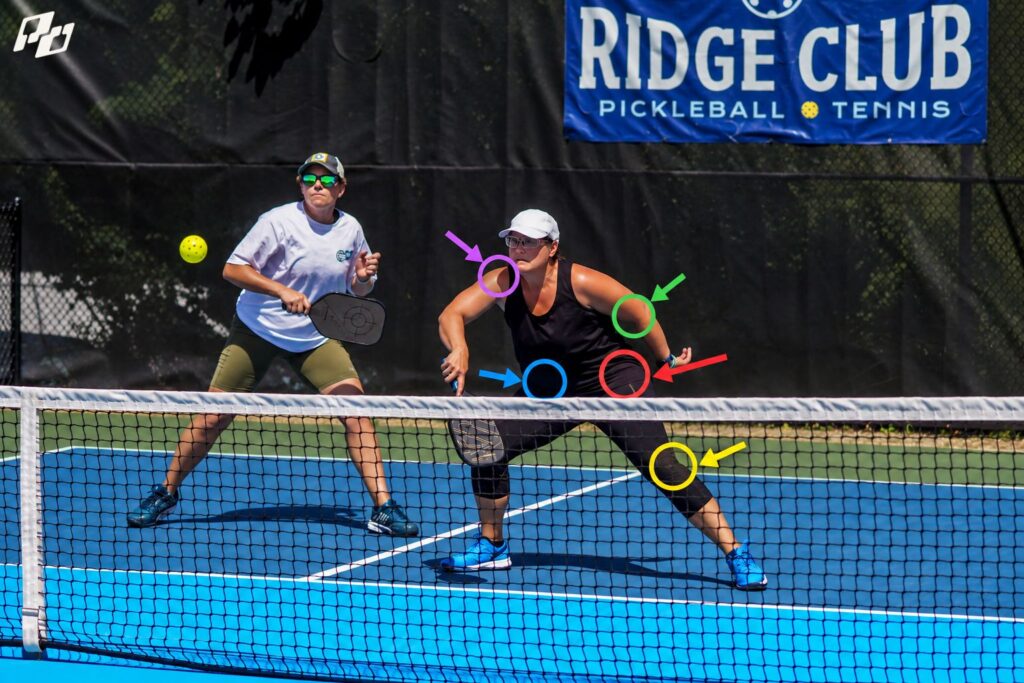
Why the feet?
Because a low contact limits what your opponent can do aggressively. A ball below net height generally has to travel upward before it can travel down into your court.
Why the body or hip?
Because it reduces comfortable swing space and can force a late decision between forehand and backhand.
Why the inside foot?
Coach Dominic Catalano specifically teaches the inside-foot target as a way to create awkward footwork and make aggressive angles more difficult.
And why movement?
Not simply because “running is tiring.” Because movement can damage contact quality.
Pro Catherine Parenteau teaches varying dink location—middle, sidelines and feet—to continually make opponents adjust rather than groove the same contact.
That’s the real goal.
Not: Make them run.
But: Make them hit before they’re completely comfortable again.
There is one catch: don’t move them just for the sake of moving them
This is where rec strategy sometimes gets sloppy.
You’ll hear: “Move them side to side!”
Fine.
But a wide crosscourt dink can also give a skilled opponent an excellent angle. A poorly chosen down-the-line dink can expose you to an Erne.
Zane Navratil makes exactly this distinction when teaching players how to escape repetitive dink patterns: moving an opponent can change the rally, but a down-the-line change should come from a neutral or offensive ball, not as a desperate bailout while you’re already under pressure. So use movement with a purpose.
A useful sequence is: Move → watch the recovery → attack the recovery.
If the movement doesn’t create a worse contact, you haven’t gained much.
The ball a “wall” loves most is often your hardest shot
This surprises players.
If somebody has excellent hands, sending them another hard, chest-high ball may be doing them a favor.
They don’t need to create pace.
You created it for them.
Now they only have to redirect it.
This is why the instinct to hit harder because nothing is working is so dangerous.
The same principle appears in experienced-player discussions. Higher-level rec players repeatedly describe improving once they stopped muscling drives at 100%, stopped using random speedups and focused instead on making balls, choosing targets and waiting for a genuinely advantageous attack. That’s anecdotal rather than experimental evidence, but the pattern is remarkably consistent.
Against a great blocker, try changing the question.
Instead of: How hard can I hit this?
Ask: Where would they least like to contact this?
A 70% ball at the backhand hip can be much nastier than a 100% drive directly into someone’s paddle.
What if they really do make everything?
Good.
Now the strategy gets fun. Stop measuring success by whether they miss. Measure the quality of what comes back.
This changes the entire experience of playing someone consistent.
Your aggressive dink gets returned?
Fine.
Was the return higher?
Did they have to step back?
Did they contact it beside their body instead of in front?
Did their reply land shorter?
Did they lose their preferred forehand?
That’s progress.
Think of each ball as changing the geometry slightly. You’re not trying to knock down a wall with one swing. You’re removing bricks.
And professional match data gives some support to this patience-first approach. In one independent database covering 66,162 shots across 73 pro matches, only 4.1% of shots were classified as outright winners, while errors ended 62% of rallies.
That isn’t a peer-reviewed dataset, so it shouldn’t be treated like a controlled scientific study, but it illustrates how little of high-level pickleball consists of immediate clean winners.
Watch their feet, not your shot
Here’s a practical cue you can use tonight.
After you hit an intentional dink, don’t admire it. Watch your opponent. Specifically, watch what their feet have to do.
If they remain square, comfortable and planted, you probably haven’t created much. If they cross over, reach, retreat, jam themselves, change direction or contact while recovering… now pay attention.
The next ball is often more important than the one that moved them.
This is also why footwork matters so much to consistency. Recreational players repeatedly report that their consistency jumps when they learn to arrive, stop and establish balance before contacting the ball rather than striking while still moving.
Your opponent understands that, consciously or otherwise. Your job is to make it difficult for them to do.
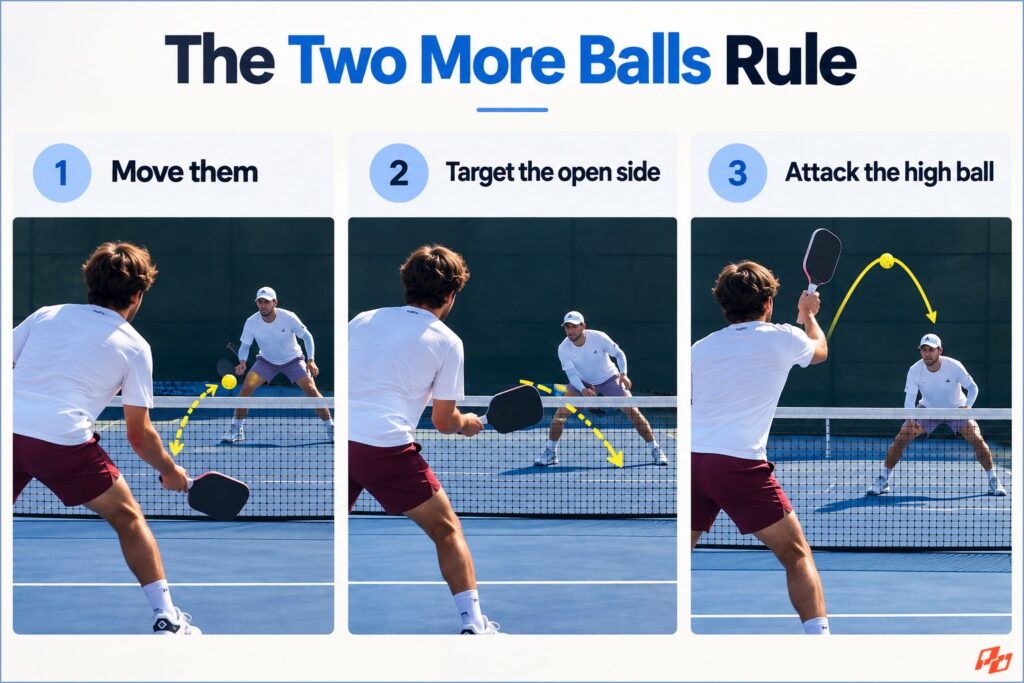
The “two more balls” rule
Here’s an experiment for your next rec game. Whenever you feel the urge to force a winner against the most consistent player on court, tell yourself: two more balls.
Not forever.
Two.
Give yourself two more intentional shots to manufacture something better.
Maybe:
1. Dink wide enough to move them.
2. Redirect toward the recovering foot.
3. Attack the resulting high ball.
Or:
1. Soft middle.
2. Backhand-side dink.
3. Attack the pop-up.
You’re not promising to rally for 40 shots. You’re simply refusing to turn a neutral ball into a low-percentage attack because you’re bored. And boredom is a real tactical problem against these players.
The “wall” is comfortable with rally number 17.
Are you?
So here’s your match plan
Against the player who never seems to miss, don’t walk onto the court thinking: Today I’m going to hit through this person.
Try this instead.
For the first few rallies, find out what kind of consistency you’re dealing with. Then stop feeding their favorite contact.
Use safe targets to create movement or a low ball. And when you finally create discomfort, don’t automatically attack the first ball you see.
- Look at their feet.
- Look at their contact height.
- Look at whether they’re balanced.
Then take the next ball.
The sequence I want you to remember is: Move them. Lower them. Attack the recovery.
Not every rally will follow that script. Pickleball is too messy for that. But the idea changes what you’re trying to accomplish.
The opponent who “never misses” probably isn’t unbeatable. They may simply be very good at hitting the comfortable balls you keep giving them.
Your job isn’t to make them suddenly inconsistent. It’s to stop letting consistency be comfortable.