
Forced errors happen when an opponent’s pressure causes the miss. Unforced errors happen when you have enough time and control but still miss. Understanding the difference helps you fix the right problem, reduce donated points, and make better decisions.
You dump a third shot into the net.
Unforced error.
Your partner leaves a ball high, the opponent smashes at your feet, and your reset catches the tape.
Probably a forced error.
Both points end with you missing. But they are not the same problem. That is why forced versus unforced errors matter so much in pickleball.
If you lump every miss together, you can end up fixing the wrong thing.
You may spend hours drilling your reset when the real issue was that your partner’s previous ball left you defending from your shoelaces.
Or you may tell yourself, “That was forced,” when you actually attacked a ball below the net and created the pressure yourself.
The useful question is not: “Did I miss?”
It is: “Who was controlling the shot?”
The simplest definition
A forced error happens when your opponent creates enough pressure that a miss becomes understandable.
An unforced error happens when you have reasonable time, balance, and control of the situation—and still miss a ball you should normally make.
Experienced players often describe it this way:
If you control the shot and miss, it is probably unforced.
If the opponent controls the shot and you miss, it is probably forced.
That is simple enough to use during a match, even though the line is sometimes subjective. Players discussing the statistic regularly point out that a difficult dink, awkward body ball, or hard firefight can sit in a gray area.
Why this distinction matters more than you think
A 2025 analysis of elite women’s PPA singles found that 63.7% of points ended in unforced errors. A men’s PPA singles analysis likewise found that nearly 60% of points ended with an unforced error. Those are singles studies, so do not treat the percentages as a direct forecast of your 3.5 doubles game—but they show how much high-level pickleball is still decided by mistakes rather than clean winners.
Now compare that with elite mixed doubles.
In one 17-match PPA study, final-shot outcomes included substantial forced-error rates: 50.2% for men and 61.2% for women, while unforced errors were around 21% for both. That tells you something important: good pickleball is not just about “waiting for mistakes.” Strong players create bad situations that make opponents miss.
So the goal is not simply: make fewer errors.
It is: make fewer unforced errors while creating more forced errors.
That is a much better definition of winning pickleball.
Unforced errors: the points you donate
These are the ones that should bother you a little. Not emotionally. Diagnostically. Typical examples:
You miss a serve.
You sail a routine return long.
You are balanced at the kitchen and dump a neutral dink into the net.
You have plenty of time on a third shot and miss it badly.
You attack a below-net ball for no reason and drive it out.
You have an easy overhead and miss it.
The common thread is not shot type. It is that the opponent did not force you into a bad contact.
Many unforced errors begin with poor shot selection—attacking from below the net, forcing angles that are not available, or choosing a drive when the ball calls for a drop. That means a lot of unforced errors are not really stroke errors.
They are decision errors.
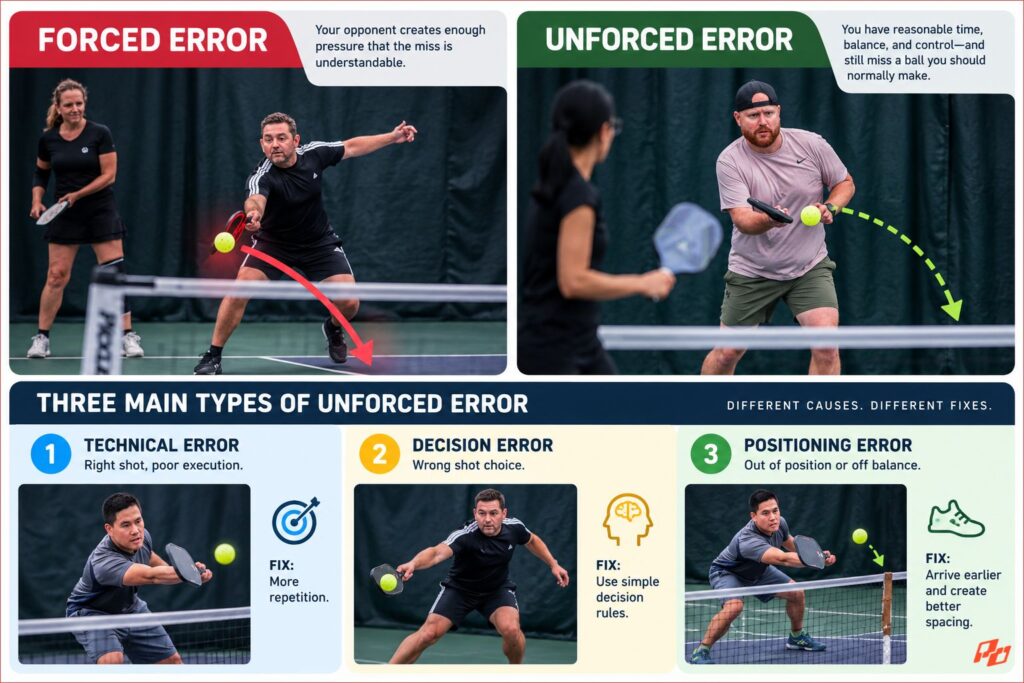
The Three Main Types of Unforced Error
Tracking errors becomes useful when you know why you missed. Most unforced errors fall into three categories:
1. Technical error
You chose the right shot and were in a good position—you simply executed it poorly.
Examples:
- Routine dink into the net
- Easy return long
- Comfortable volley wide
Fix: Repetition. This is where drilling helps.
2. Decision error
Your stroke may have been fine. The problem was choosing the wrong shot.
Examples:
- Speeding up a ball below the net
- Going for a sharp angle while stretched
- Driving from transition while moving backward
Fix: Use simple decision rules.
For example:
Below the net → neutralize
Above the net + balanced → attack
Simple rules reduce poor choices when the rally speeds up.
3. Positioning error
This is the sneaky one. The final swing looks like the problem, but the mistake often happened a second earlier.
Maybe you:
- Arrived late
- Hit while drifting
- Got too close to the bounce
- Failed to split-step
You miss a drop and think, My drop is terrible. Maybe. Or maybe your footwork made a good drop almost impossible.
Fix: Arrive earlier, stop before contact, and create better spacing.
That’s also why good error review looks beyond the final shot. The rally-ending miss may have been created one, two, or even three shots earlier.
Forced Errors: The Points Your Opponent Earns
Now flip the perspective. A forced error still shows up as a miss, but the real cause is often the pressure your opponent created.
Maybe you:
- Get jammed at the body
- Stretch wide for a dink
- Take a hard volley at your feet
- Get pulled off court and miss the next ball
The stat says error. Tactically, your opponent may have earned it.
That matters because the fix usually is not: “Stop missing.”
It is: “Stop giving them that attacking ball.”
Look at what happened before the miss
Suppose you miss a reset at your feet. Instead of blaming the reset, ask: Why was I receiving a ball at my feet?
Maybe:
- Your drop sat high
- A dink popped up
- You advanced too quickly
- You left too much middle
- Your opponent simply hit a great shot
Those are very different problems.
Forced errors are often the end of a chain. The goal is to break that chain earlier.
How to reduce forced errors
You cannot eliminate them. Sometimes your opponent simply hits too good a ball. But you can make yourself much harder to pressure.
✔️ Improve your neutral ball.
A lower dink, deeper return, better reset, or drop below the knees may not win the rally—but it makes the next attack harder.
✔️ Do not advance behind a bad ball.
A mediocre third-shot drop is not an automatic invitation to rush the kitchen. If it sits high, hold your position, split-step, and earn the next move forward.
✔️ Defend one more ball.
When pressure comes, resist the urge to do something spectacular. Block one more. Reset one more. Make your opponent earn another attack.
That is why strong defenders often look so calm: they are not trying to turn every defensive ball into offense.
The gray area: whose error was it really?
This is where error statistics get messy. Imagine this:
You hit a slightly high dink.
Your opponent speeds it up.
You miss the counter.
Was that a forced error?
On the final ball, yes. But you created the attackable ball. That is why classifying only the final stroke can sometimes hide the real mistake.
A useful rec-player system is:
UE = unforced error
FE = forced error
SETUP = I created the pressure that forced the later miss
That third category is incredibly valuable. Now your post-game notes might look like:
3 UE
5 FE
2 SETUP
Much better than: “I missed 10 balls.”
A popup is not always an error on the stat sheet—but treat it like one
Technically, if you pop up a dink and your opponent smashes the next ball for a winner, the rally-ending shot is the opponent’s winner, not necessarily your unforced error.
But from a coaching perspective?
Track the popup.
Experienced players make this distinction constantly: the popup may not officially be the point-ending error, but it often creates the point-ending ball.
For improvement, the important question is not what the official scorer would call it.
It is: did my shot create an easy attack?
If yes, write it down.
A Better Way to Diagnose the Miss
Before you try to fix a mistake, diagnose it. The same missed ball can come from bad execution, a bad decision, poor positioning, or genuine opponent pressure.
| What happened | Likely category | What probably caused it | What to fix |
|---|---|---|---|
| Routine dink into the net while balanced | Unforced | Execution | Contact point, margin, repetition |
| Speed-up from below the net goes long | Unforced | Decision | Better attack threshold |
| Return sails long with plenty of time | Unforced | Execution | Target depth with more margin |
| Reset misses after a hard ball at your feet | Forced | Opponent pressure | Earlier preparation, softer hands, better positioning |
| You get stretched wide and miss the next dink | Forced | Opponent moved you | Recovery footwork and court position |
| Your high dink gets attacked and you miss the counter | Setup error + forced error | Previous ball created pressure | Keep neutral balls lower |
| You rush forward behind a high drop and get attacked | Setup/positioning error | Advanced behind a bad ball | Hold, split-step, earn your way forward |
| High attackable ball goes into the net | Unforced | Execution | Cleaner contact and controlled acceleration |
| Opponent hits a perfect passing angle you barely reach | Forced | Quality opponent shot | Accept it; improve anticipation if pattern repeats |
What should you actually track?
Not every shot. You will drive yourself crazy. For one game, track only these four:
Routine misses
Serve, return, neutral dink, comfortable drop.
Bad decisions
Low-ball attacks, unnecessary angle attempts, rushed drives.
Pressure misses
Balls you genuinely struggled to handle because the opponent created pressure.
Setup mistakes
The high dink, weak drop, or poor positioning that led to the opponent’s attack.
That gives you a much better picture of your game.
Then look for the pattern, not the total
Suppose you finish with six unforced errors. That number alone tells you almost nothing. But this does:
4 into the net
1 long
1 wide
Now you have information.
Mostly net can suggest:
- late contact
- poor balance
- too little margin
- or attacking balls that are too low
Mostly long or wide can suggest:
- overhitting
- opening the paddle face
- using targets that are too small
- or accelerating beyond your control
This type of error-location tracking is much more actionable than simply saying “be consistent.”
Do not become so obsessed with unforced errors that you stop playing offense
This is the trap. A player hears: “Cut errors.” So they dink everything.
They stop speeding up.
They never poach.
They never attack a high ball.
Then they proudly finish with one unforced error—and lose 11–4.
Experienced players have described exactly this problem: very low unforced-error totals do not automatically mean good pickleball if you are not creating pressure or finishing opportunities.
The goal is not zero risk.
It is good risk.
A missed attack on a clearly attackable ball is not the same problem as a wild speed-up from your ankles.
One may be an execution miss worth continuing to develop. The other is a bad decision.
The best match goal: change the ratio
Here is a more useful goal than “make fewer mistakes.”
After a game, ask: How many points did I donate?
Then: How many errors did I force?
If you can reduce your donations while making your opponent hit more uncomfortable balls, you are improving even if your winner count barely changes.
That is why the forced-versus-unforced distinction matters. It changes the way you see a rally.
A missed ball is no longer automatically: “I need a better stroke.”
Sometimes it means: I chose the wrong shot.
Sometimes: I arrived late.
Sometimes: My previous ball created the attack.
And sometimes: That was simply a great shot by the opponent.
Those require four different fixes.
Treat them like one problem, and improvement gets blurry. Separate them, and suddenly your practice plan becomes obvious.
Do not just count your misses.
Find out who caused them.