
Better pickleball players often use more net clearance than intermediates expect. The goal isn’t to skim the tape—it’s to create a ball that clears safely, then drops into a difficult contact zone. More margin can improve drops, topspin drives, resets, and dinks while reducing cheap errors.
A 3.8-rated player recently described a coaching change that immediately made his pickleball feel easier.
A 5.2 player told him to stop trying to skim every ball over the tape. Instead, he was told to imagine that the net had become roughly one paddle face higher.
He tried it.
His errors dropped. His rallies felt slower. He stopped trying to win points from balls that were not really attackable. And he described playing some of the best pickleball of his life.
The interesting part is that the advice was not really about hitting the ball higher. It was about stopping the net from controlling his decisions.
The breakthrough was this:
The height that matters most is not where your ball crosses the net. It is where your opponent contacts it.
That changes almost everything.
There are actually three heights in every shot
Intermediate players often think about only one: net clearance. Did I clear it by two inches? Six inches? A foot?
Better players are also thinking—consciously or not—about two other heights:
The apex of the ball’s flight
and
the opponent’s contact height.
Those are not the same thing.
A third-shot drop can travel well above the tape, reach its highest point before the net, and then be falling sharply by the time it reaches the kitchen.
That ball may look “high” halfway through its flight but still force the opponent to hit from below net level.
Meanwhile, a flatter ball can skim two inches above the tape and continue traveling horizontally into an opponent’s comfortable volley zone.
Which ball was actually safer? Probably the one that looked higher.
USA Pickleball teaches players to loft the third-shot drop in an arc so that the ball begins its arc before the net and falls near the opponent’s feet. Its newer coaching material also explicitly advises players to miss deep rather than low: a slightly deep drop keeps the rally alive, while a ball in the net ends it immediately.
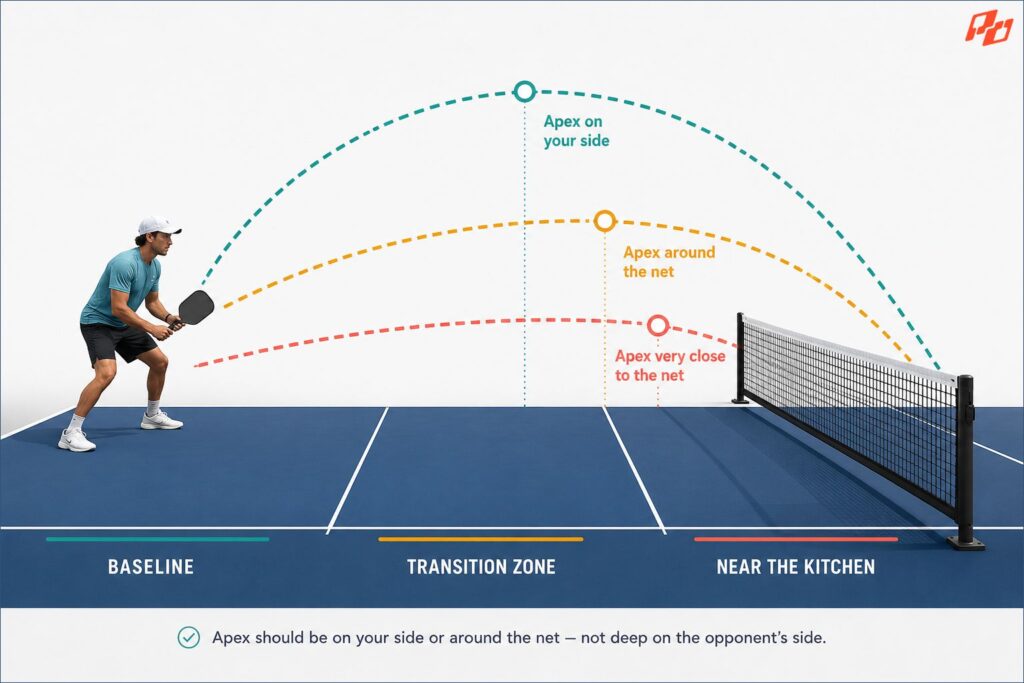
That is a very different mindset from: “Keep everything as low over the net as possible.”
Stop trying to beat the net
This is probably the transition a lot of 3.5–4.0 players need. You become good enough to control the ball, so you start trying to make every shot better by shaving away margin.
The return goes deeper.
The dink gets lower.
The drive clips closer to the tape.
The angle gets sharper.
Eventually you are playing a version of pickleball where every neutral shot has to be almost perfect.
That is what the Reddit player realized his coaches were correcting.
Both coaches told him to stop trying to win from non-winning situations. He explained that his third-shot drives had become attempts to end the point rather than shots designed to create the next opportunity. The result was unnecessary net errors and premature speed-ups.
The higher-net cue fixed more than trajectory. It changed shot intention.
Think “landing shape,” not “net height”
Here is a better question to ask: what is the ball doing after it clears the net?
Is it:
Still rising?
Traveling flat?
Or already falling?
That matters much more than whether it passed the tape by four inches or ten.
Take a topspin drive.
Topspin can make a moderately paced drive more effective than a harder flat ball because the spin helps the ball dip sooner and can force the opponent to contact it below net height.
So instead of trying to hit: hard + low you can often hit: up + through + down.
The ball clears the net with margin, then dips. That is a much friendlier geometry.
The same idea works on drops—but with a different shape
This is where players sometimes misapply the advice. “Aim higher” does not mean float the third shot six feet above the net.
The ball should have a controlled arc, with its peak occurring before the net, so it is descending as it enters the kitchen.
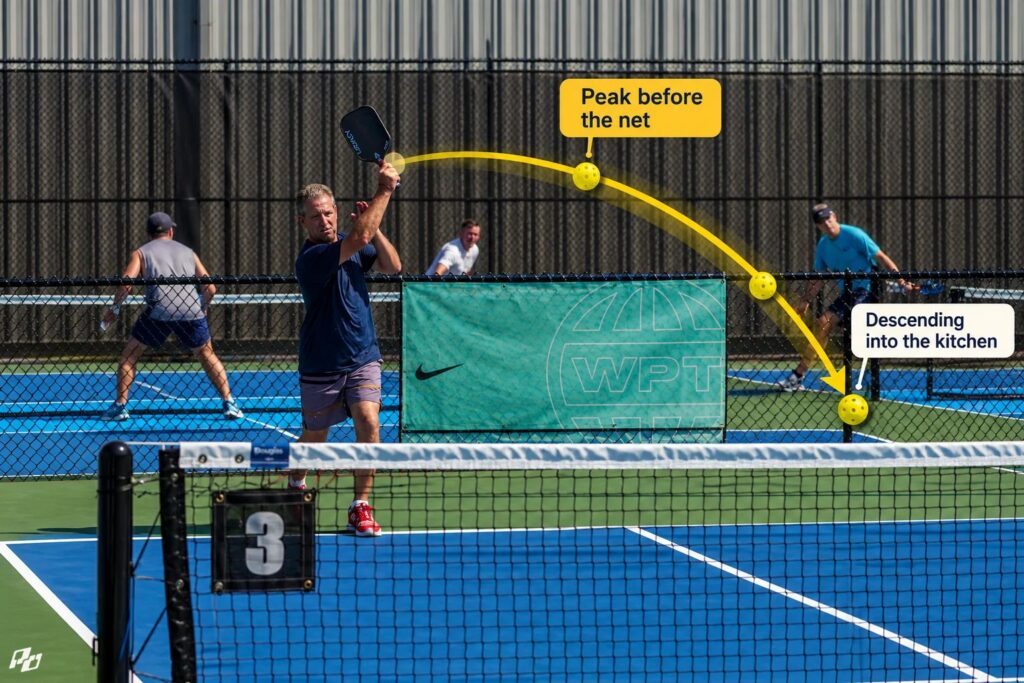
That gives you two advantages.
- You create net clearance early.
- Then gravity does the defensive work for you.
The ball is not trying to sneak horizontally through a tiny window. It is traveling over the obstacle and then falling into the target.
Think: up early → peak early → fall late.
Not: flat → flat → please clear the tape.
Where you miss matters
This may be the most useful part of the entire concept. There are two common third-shot misses.
Miss A:
You hit the ball eight inches too high, it lands a little deeper than intended, and your opponent volleys it.
Not ideal.
But you are still playing.
Miss B:
You try to hit the perfect drop and catch the tape.
Point over.
Your first priority is to clear the net and keep the ball in play; landing perfectly in the kitchen comes second.
That does not mean you should become careless about height. It means your errors should have a preferred direction.
Slightly high is recoverable.
Into the net is terminal.
Intermediate players often optimize for the perfect ball instead of the survivable miss.
Try the imaginary second net
For one rec session, imagine another net sitting roughly one paddle face above the real one. You do not have to literally send every shot over that imaginary line. Use it as a visual reset.
Especially on:
- third-shot drops
- neutral transition balls
- baseline drives
- and defensive dinks where you are stretched or late
The cue stops you from trying to thread balls through a window you do not need. But there is an important exception.
Do not use the same clearance on every shot
This is where simplistic advice falls apart.
A neutral crosscourt dink is not the same shot as a third-shot drop. A drive with topspin is not the same as a flat volley.
The useful margin changes with the shot.
| Situation | Useful Margin Idea | What Matters Most |
|---|---|---|
| Third-shot drop | More arc and comfortable clearance | Ball descending into kitchen |
| Topspin drive | Enough height to allow dip | Opponent contacting low |
| Neutral crosscourt dink | Moderate clearance | Depth + unattackable bounce |
| Straight-ahead dink | Less geometry available | Precise height and depth |
| Defensive reset | Prioritize clearing net | Staying alive |
| Attackable high ball | Lower trajectory is fine | You already own contact height |
The mistake is not hitting high. The mistake is hitting high without a reason.
Crosscourt buys you margin for free
This is another reason advanced players look more relaxed. They often choose geometry that gives them margin before they even swing.
Middle and crosscourt shots offer more margin because they travel over the lower part of the net and give you more court to work with. The net is 34 inches high in the center and 36 inches at the sidelines, so your target direction directly affects how much margin you have.
That means a good player does not always need to become more precise. Sometimes they simply choose a shot that requires less precision.
That is a much more advanced idea.
The “two-ball” test
Here is a better drill than simply trying to hit 50 balls as low over the net as possible.
Pick one shot—a third-shot drop, topspin drive, reset, or neutral crosscourt dink—and hit two versions from the same position.
Ball one:
Try to skim the net.
Ball two:
Give yourself noticeably more clearance while keeping the same general target.
Then stop judging the shot by how low or pretty it looks. Judge what happens after it clears the net:
Where does it land?
Is it rising, flattening out, or already descending?
What height would your opponent contact it at?
Could they attack it comfortably?
Did the extra margin actually make the shot less effective?
Repeat the comparison with different shots.
On a third-shot drop, you may discover that another 6–12 inches of clearance still produces a ball dropping below the opponent’s attack zone.
On a topspin drive, you may find that a slightly higher trajectory gives the spin more room to pull the ball down and produces a lower contact at the other end.
On a reset, the higher-margin ball may simply keep you alive instead of dying in the tape.
And on a crosscourt dink, a little more arc may let you create better depth without making the ball attackable.
You may find something uncomfortable: the ball that looks lower is not always the ball that creates the lower contact.
The danger of becoming too safe
There is a limit to all of this.
One experienced player responding to the original Reddit post made an important point: once you reach stronger competition, completely neutral play can become passive. Better opponents may redirect toward your weaker partner, attack balls you thought were safe, or simply wait until they create the opening themselves.
So the goal is not: hit everything higher and softer.
The progression is:
- First, stop donating points.
- Then learn which balls actually deserve aggression.
That is a much healthier path from 3.5 toward 4.0+ than trying to manufacture pressure on every contact.