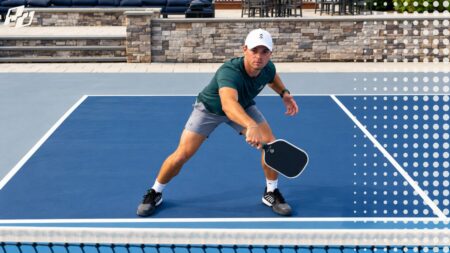
At the kitchen, shift your weight toward the ball when your court position is already good. Shuffle only when the ball changes the angle enough that you need to reposition. The goal is to stay balanced, connected to your partner, and ready to counter—not to move your feet after every dink.
Watch JW Johnson at the kitchen and one thing stands out. He often looks almost casual.
The ball moves left. Then right. His opponents shift. His partner moves. Yet JW is not constantly shuffling three feet in every direction.
Instead, he makes small positional adjustments and shifts his balance toward the side of the ball so he is already loaded for the next counter.
That is an important distinction for recreational doubles players. You do need to move with the ball.
But “move with the ball” does not mean your feet have to shuffle every time the ball changes direction.
Sometimes the correct adjustment is physical movement. Sometimes it is simply a weight shift inside your existing stance.
Knowing the difference can make your kitchen defense and counters noticeably quicker.
The Basic Idea: Track the Ball With Your Base
Imagine you are standing at the kitchen with a wide, balanced stance. The ball is across the net and slightly to your right.
Instead of remaining perfectly centered, allow a little more pressure to settle into your right leg.
If the ball moves across toward your left, transfer that pressure toward your left leg.
You have not necessarily moved your feet. You have changed where your body is loaded. Why does that matter?
Because the loaded leg becomes the platform you can push from if the opponent speeds the ball up.
Cue
Ball right, load right. Ball left, load left.
Not your entire body weight. Just enough that you are prepared to push back toward the ball.
Watch JW Johnson—the player across the net on the left side of the court—and pay close attention to when he actually shuffles versus when he simply loads his weight in the direction of the ball.
Why This Helps Your Counter
A counter is not generated entirely by your arm. Even on a compact kitchen counter, your lower body gives the shot its platform.
If the incoming ball is to your right and your weight is already organized over the right side, you can:
- stay balanced through contact
- push subtly through the floor
- keep the upper body quieter
- redirect pace without reaching
- recover faster for the next ball
If your weight is sitting on the wrong leg, you often have to move your body before you can move the paddle effectively.
That costs time. At kitchen speed, even a tiny delay matters.
This is why the idea of a “load leg” is useful. The leg on the ball side provides the base from which the upper body can react.
Watch Coach Wynn Johnson break down the concept of weight transfer in this short video below—it’s an eye-opening explanation.
But Don’t Turn the Weight Shift Into a Lean
This is where recreational players can misinterpret the advice. If the ball is to your right, you do not want to tip your entire torso dramatically to the right.
Your head should remain relatively centered.
Your knees stay flexed.
Your chest stays forward.
Think about pressure through the leg, not collapsing onto it.
A good weight shift is subtle enough that someone watching from across the court may barely notice it.
The purpose is to preload the body. Not to commit your entire center of mass before you know where the next ball is going.
When a Weight Shift Is Enough
A weight shift works when the ball is moving within the area you already cover comfortably. For example, your partner dinks from the right half of the court toward the opponent directly in front of you.
You do not necessarily need to shuffle two feet.
This is particularly useful during quick dink exchanges when the ball changes direction often but nobody has been pulled far enough to create a major positional gap.
Excessive “happy feet” can actually make kitchen defense worse because you are still moving when the opponent attacks.
When You Actually Need to Shuffle
A weight shift cannot replace real court coverage. If the ball moves far enough that your current position leaves an open lane, move your feet.
Use a lateral shuffle when:
- your partner gets pulled wide
- the opponent creates a sharp crosscourt angle
- your team needs to close or reopen the middle
- you would otherwise have to reach beyond your stable base
- the ball has shifted enough that your court responsibility changes
Coach Jordan Briones describes this as shading: your team adjusts laterally based on where the ball is and which lanes need to be protected.
The key is not whether to shift or shuffle. It is how much adjustment the ball actually requires.
Think of three levels
| Ball Movement | Your Response |
|---|---|
| Small change inside your coverage | Weight shift |
| Moderate change in angle | Micro-shuffle + weight shift |
| Big crosscourt/wide movement | Real lateral repositioning |
That is much more useful than automatically mirroring the ball foot-for-foot.
“Move With the Ball” Is Often Taught Too Literally
Many recreational players learn a simple doubles rule:
“If the ball moves three feet, you move three feet.”
That is a helpful beginner concept because it teaches team connection.
But better doubles positioning is more flexible. Your partner may need to move three feet while you move only one.
Or you may barely move at all and simply shift your weight because your current position already protects the important lane.
Doubles positioning still requires the team to respond together, but good teams do not necessarily move identical distances on every ball.
This is especially important when the ball is near the sideline.
If your partner moves wide and you copy them too aggressively, you may end up guarding out-of-bounds space while leaving the middle open.
Track the Ball, But Read the Opponent Too
The ball tells you where to load. The opponent tells you what to prepare for.
Suppose the ball is on your right. You bias slightly toward the right leg. Now look at the opponent’s contact.
If they are:
- balanced
- contacting high
- paddle prepared in front
be ready for pace.
If they are:
- stretched
- contacting below net height
- reaching outside their base
you may have more freedom to remain aggressive toward the middle.
This matters because kitchen positioning is not just geometry. It is probability. Where the ball is changes the available angles.
How the opponent reaches that ball changes which of those angles they can realistically execute.
Why Pros Look Like They Barely Move
High-level players often seem to have “faster hands.” Sometimes they simply have earlier preparation.
They are not waiting for the speed-up before organizing their feet.
The ball moves.
Their pressure shifts.
Their paddle position adjusts.
Their base is already loaded.
Then the attack comes.
That is why someone like JW Johnson can look almost relaxed during a sequence that would have a recreational player bouncing frantically from side to side.
Efficient footwork is often less movement—not more. The body is simply in the right place earlier.
Don’t Lose Your Split-Step
There is one important limitation to the weight-shift concept. You still need to be stable when the opponent contacts the ball.
If you are in the middle of a large shuffle or transfer when they speed up, your reaction becomes harder.
A subtle split-step or balanced settling action as the opponent contacts the ball helps stop unnecessary momentum and lets you react in either direction.
Move while the ball is traveling, then arrive balanced for the opponent’s strike.
So the rhythm becomes: Ball moves → adjust → load → opponent hits → react.
Not: Ball moves → keep moving → get attacked while moving.
What Should Your Paddle Do?
Your lower body is following the ball, but your paddle should also remain connected to that movement.
You do not need to physically point the paddle at the ball.
But as the ball changes sides, allow your shoulders and paddle orientation to adjust subtly so your hands stay in a useful defensive window.
Against a potential speed-up, keep the paddle:
- in front of the torso
- compact
- neutral enough to access both sides
- not drifting behind the body as your weight changes
The weight shift should make the counter easier. It should not create a big upper-body windup.
The Biggest Recreational Mistake: Shuffling Without a Reason
Some players hear “stay active at the kitchen” and begin moving their feet constantly.
Left.
Right.
Bounce.
Shuffle.
Bounce again.
Then the opponent attacks while they are halfway between steps.
Activity is not the goal.
Readiness is.
If you are already in the correct spot, stay there. Shift pressure toward the ball.
If the geometry changes enough that your position is no longer correct, move. That is a much more efficient decision system.
Cue
Shift first. Shuffle only when you need court.
A Simple Drill to Feel the Difference
Stand at the kitchen with your partner across from you. Have them dink slowly between three locations:
- your right;
- middle;
- your left.
For the first round, do not move your feet unless the ball is truly outside your comfortable reach.
Simply transfer pressure:
right ball → right leg
middle ball → neutral
left ball → left leg
Then add random speed-ups.
Your goal is to feel how much easier the counter becomes when your base is already loaded toward the incoming ball.
Next, widen the dink angles. Now allow one small shuffle whenever a weight shift alone is no longer enough.
That teaches the distinction:
Weight shift solves preparation.
Shuffle solves position.
How I’d Know Whether to Shift or Shuffle
You should absolutely track the ball at the kitchen. But stop assuming that tracking means your shoes have to follow it every time.
If your court position is already good, shift your balance toward the ball and stay loaded.
If the ball changes the geometry enough that your lane or your partner’s lane opens up, shuffle and reposition.
Then settle before the opponent makes contact.
The best kitchen movement is not the movement that looks busiest. It is the smallest movement that leaves you balanced, connected to your partner, and ready for the next ball.
So remember:
Move your weight when you can. Move your feet when you must.
That is how you stay quieter at the kitchen without becoming flat-footed—and how you make your counter feel much faster without changing the counter itself.