4.0+ pickleball players move their body into position instead of reaching for dinks. They read the ball early, use small adjustment steps, create proper spacing, and get balanced before contact. This keeps the paddle quiet and makes dinks more controlled, repeatable, and easier to disguise.
Here’s something to watch the next time you play with a strong 4.0+ player. Send a dink a couple of feet away from them.
They could reach it.
But they usually don’t.
Instead, their feet move. Their hips follow. They get their body into a better position and then hit what looks like a ridiculously easy dink.
That little movement is one of the most understated differences between intermediate and advanced recreational pickleball.
A 3.5 player often thinks: “Can I reach the ball?”
A 4.0+ player is thinking: “Can I get my body into position behind the ball?”
That distinction matters much more than it sounds.
Because the farther your paddle gets from your body, the more your hand has to compensate for poor spacing.
The Mistake: “I Can Reach It From Here”
Picture a crosscourt dink coming 18 inches outside your comfortable contact point.
You don’t have to move.
So you extend the arm.
Maybe you lean slightly.
You make the dink.
What’s the problem? You just practiced hitting from a compromised position.
Your weight is now outside your base. Your arm is extended. Your contact point is farther from your body, and you’ve reduced your ability to change direction or disguise the next shot.
Do that repeatedly and your dinking starts becoming a series of little saves.
Reach. Recover. Reach. Recover.
Better players make the feet do that work instead.
If you have time to move your body closer to the ball, don’t voluntarily hit from the edge of your reach.
That’s the habit.
What “Get Behind the Ball” Actually Means
Don’t take this too literally. I’m not telling you to put your belly button directly behind every dink. The goal is to move enough that the incoming ball ends up inside your comfortable strike zone.
Think of an invisible V-shaped window extending out from the center of your body—one side for forehands, one for backhands. The goal is to keep your dinks, drops, and resets inside that V, instead of reaching to full arm extension and losing control.
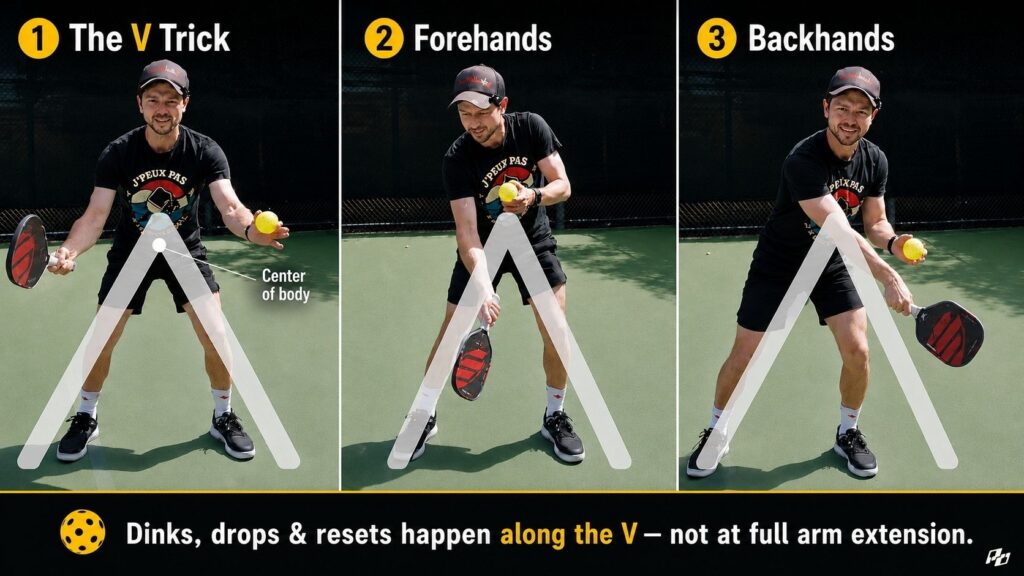
Inside that window, you can:
- contact comfortably in front
- keep your balance
- control the paddle face
- change direction
- add spin
- disguise your shot
- recover quickly
Outside that window, your options begin disappearing.
So rather than asking your arm to stretch the strike zone, move the strike zone with your feet. That’s what good kitchen footwork really does.
The Footwork Pattern Most Rec Players Miss
Here’s where the difference becomes visible.
A typical intermediate pattern is: See ball → take one big step → reach → hit.
A stronger pattern is: See ball → move → adjust → set → hit.
That second little adjustment is important.
Your first movement gets you near the ball.
Your adjustment steps give you the correct spacing.
Sometimes we’re talking about only a few inches. But those few inches determine whether you’re hitting from a stable position or leaning into the shot.
Check out this pro highlight featuring ALW and Jorja Johnson. Watch their footwork—the small step-back creates space, keeps the ball in front, and preserves a strong defensive position:
@ghostmammoth Pickleball Footwork Mastery: The Kitchen. Want to stop getting beat at the kitchen line? This pro pickleball highlight shows ALW and Jorja Johnson using the perfect step-back technique. By keeping the ball in front, they maintain defense strategy control and set up better attacks. Watch their feet! Is your footwork the strongest part of your game? Let's talk strategy below! ↓ @Major League Pickleball #propickleball #pickleballstrategy #mlp #ALW #pickleballhighlights ♬ original sound – Ghost Mammoth Pickleball Club
Try this cue:
Big movement gets you there. Small steps get you organized.
You don’t need faster feet. You need feet that keep adjusting until the spacing is right.
The Surprising Part: Sometimes You Need to Move Away From the Ball
This is where the concept becomes especially useful.
We’re always told to move toward the ball. But getting your body into position sometimes means doing the opposite.
Imagine a deep dink coming toward your inside foot. You’re standing right at the kitchen line. If you refuse to give up any ground, the bounce gets underneath you. Now your leg is occupying the space where your paddle needs to travel. So you improvise.
You lift the elbow.
You flick the wrist.
You lean backward.
Then you wonder why a routine dink pops up.
The problem wasn’t necessarily your hands. You were too close to the ball.
A good player recognizes that trajectory early and creates space. A small step backward or diagonally backward can move the hip and leg out of the paddle’s path.
Now the same awkward ball becomes a comfortable dink.
You may only need six inches.
You may need a foot.
The exact number doesn’t matter.
Use this rule:
Back up only enough to restore your normal contact point.
Then take the kitchen line back.
You aren’t retreating.
You’re creating space.
Coach Jordan Briones shows you exactly how to handle inside-foot dinks:
@brionespickleball Stop Freezing On Inside Dinks! Do This Instead! #pickleball #pickleballtips ♬ original sound – Briones Pickleball
One More Key: Get There Early Enough to Become Quiet
Here’s another difference worth watching.
Good players can have very active feet before contact and look remarkably quiet during contact.
That’s what you want.
- Move.
- Adjust.
- Set.
- Hit.
What you don’t want is: move → drift → reach → hit while falling sideways.
If your body is still carrying significant lateral momentum at contact, your hand has to compensate for it.
That’s when paddle-face control becomes harder.
Cue:
Fast feet. Quiet hands.
Let the feet create the contact point so your hand doesn’t have to rescue it.
Don’t Take Three Steps When Zero Will Do
There’s a flip side.
Once players learn this concept, some start dancing around every dink. That’s not advanced footwork either.
If the ball is already arriving in your ideal strike zone, don’t move just because someone told you 4.0 players move their feet.
The goal is efficiency.
Sometimes you need three adjustments.
Sometimes one.
Sometimes none.
The advanced skill is recognizing the difference.
Use the minimum movement necessary to create a high-quality contact point.
Three More 4.0+ Footwork Keys Worth Stealing
Once you start thinking about body position rather than paddle reach, a few other kitchen habits make much more sense.
1. Read the Bounce Before You Choose the Footwork
Don’t wait for the ball to land before deciding where to move. Read the trajectory early.
Watch three things:
- Height over the net: lower balls usually land shorter; higher, deeper dinks tend to push farther toward your feet.
- Speed: a firmer dink carries deeper; a softer one dies sooner.
- Angle: crosscourt balls travel farther and can pull you wider.
Then make the decision early:
Short = step in.
Wide = move laterally.
Deep = create space.
Reachable in the air = consider volleying it.
Cue
Read the flight, predict the bounce, move before it lands.
2. Don’t Automatically Use One Giant Step
One large lunge can get your paddle to the ball quickly, but it often leaves you stuck there. Whenever time permits, use smaller adjustment steps to refine your spacing.
There’s a reason good players seem to take so many tiny steps around the kitchen. They’re constantly recalibrating the distance between:
body → paddle → ball.
That relationship matters more than putting your toes in one exact location.
3. Recover Your Body, Not Just Your Paddle
After a wide dink, intermediate players often bring the paddle back to ready position while leaving their body leaning toward the previous shot. That’s not a full recovery.
Get your base underneath you again. Then read the opponent. Otherwise the rally can turn into:
reach right → reach left → reach right → pop up.
Once the feet stop recovering, every subsequent contact gets a little harder.
Try the “No-Reach” Dinking Drill
This drill teaches you to move your body to the ball instead of stretching your paddle toward it.
Setup: Crosscourt dink with a partner for 5 minutes.
The rule: If you have time to move, you are not allowed to hit from the edge of your reach.
Have your partner mix in:
- wide dinks
- balls into the body
- inside-foot dinks
- short balls
- deep dinks
Your job is to make each contact feel as if the ball was fed into your ideal strike zone.
Think:
Move → adjust → set → hit
Then play another 5 minutes normally.
What you should notice: the paddle feels quieter, the contact feels cleaner, and you spend less time rescuing balls with your hand.
What Level Should Work on This?
This is primarily a 3.5-to-4.0+ development skill.
If you’re around 3.0, don’t turn kitchen footwork into an elaborate dance yet. First become comfortable sustaining dinks, controlling height, keeping the paddle stable and understanding basic kitchen positioning.
But once you’re a solid intermediate player, “just get the ball back” isn’t enough. Start evaluating the quality of the position you hit it from.
That’s where this concept becomes powerful.
At 4.0+, you’re increasingly trying to preserve enough balance and spacing to do more than merely dink the ball back.
You want the option to: dink safely, attack, add spin, change direction, disguise the shot or counter if the next ball comes fast.
Good spacing preserves those choices.
Watch a 4.0+ Player’s Feet, Not Their Paddle
Next time you watch advanced pickleball, ignore the shots for one rally.
Watch the feet.
You’ll see constant little adjustments:
Shuffle.
Tiny step.
Back up.
Move forward.
Two quick steps sideways.
Set. Hit.
None of it looks impressive.
That’s why intermediate players miss it.
The paddle gets the attention, but the feet are quietly creating better spacing, balance, and contact before every shot.
The difference is simple:
3.5 players often move the paddle to the ball.
4.0+ players move their body so the ball comes to their paddle.
That’s what “move your feet” really means.