
Ask a pickleball player about injuries and you’ll hear about tennis elbow, a cranky shoulder, a calf that went pop. Ask an emergency room and you get a different sport. A new national analysis of ER visits found that the shoulder and arm injuries that end up there are mostly broken bones, mostly in players over 60, more often in women, and its authors say falls were the leading cause.
That’s not a reason to quit. Nine in ten of those patients were treated and sent home the same day. But it puts falls at the center of the story. Here’s what the research says about how falls on court happen, what a 10-week training program did for senior players, and who should ask a doctor about bone density.
What the ER sees
The study, published in June 2026 in the Journal of Orthopaedic Experience & Innovation, looked at pickleball injuries to the shoulder, upper arm, elbow and forearm in the Consumer Product Safety Commission’s national sample of emergency departments from 2014 to 2023. The researchers found 250 recorded cases, which works out to an estimated 14,916 ER visits nationally. Wrist and hand injuries were not part of this count.
- Who: average age 67. 83% were over 60. 59% were women.
- What: 59% were fractures. Strains and sprains were 11%, dislocations 11%.
- Women vs. men: 72% of the injuries in women were fractures, compared with 40% in men.
- Where: shoulder 37%, forearm 35%, elbow 14%, upper arm 14%.
- What happened next: 90% were treated and released, 8% were admitted.
The paper says falls were the leading way these injuries happened, but it doesn’t give a percentage. An earlier study using the same ER data, covering all body parts from 2010 to 2019, does: a slip, trip, fall or dive caused 63% of pickleball injuries at all ages and 67% among players 60 and older. In that study, women had 3.7 times the odds of a fracture that men did.
Who is most exposed, and why the authors think so
The patients in the study were mostly in their sixties and seventies, and the authors tie the pattern to falls and bone health: their advice to doctors includes bone health assessments and bone density screening under US Preventive Services Task Force guidelines. The Task Force puts numbers on why women stand out: among Americans 65 and older, about 27% of women and 6% of men have osteoporosis.
The authors’ advice for doctors is practical: counsel players on a proper warm-up, appropriate footwear and bone health checks. In the discussion they add resistance and balance training, clearing tripping hazards from courts, and conditioning for the shoulder and forearm. For more on balance and footwork, see our guide to staying balanced on court.
How falls on court happen
Only a few studies have asked pickleball players about their falls directly. One, published in 2024 in the International Journal of Sports Physical Therapy, surveyed and tested 92 recreational players aged 18 to 79.
- 42% said they had fallen while playing, and 30% had fallen more than once.
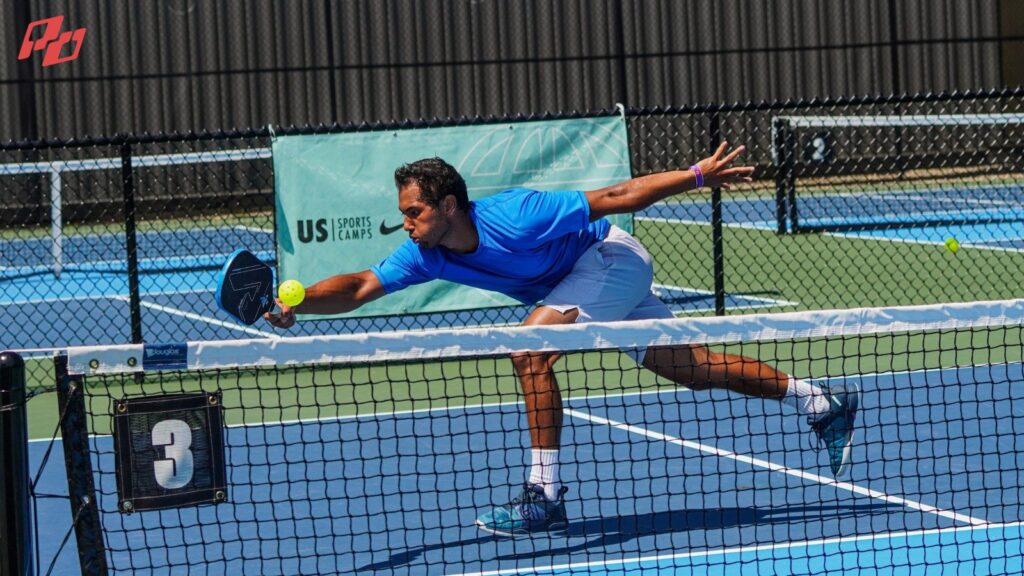
- Lunging was the most common situation (57% of the falls players described), followed by moving backward (24%). Running into another player, the fence or the net made up the rest.
- Players who had fallen were older and slower on a pickleball change-of-direction test (9.1 seconds vs. 8.2). Hip strength did not differ between the groups.
Keep the limits in mind: falls were reported from memory, it’s one group of 92 players, and people may judge differently what counts as a fall. The authors conclude that “falls are common among recreational pickleball players, particularly older players,” and suggest training programs that include lunging in multiple directions, leg strength and power, and backward change-of-direction work. Our guide to falling safely in pickleball covers what to do when you do go down, and our dink footwork guide covers footwork at the kitchen line.
The 10-week program researchers tested, and what it changed
The same two researchers, Betsy Myers and June Hanks of the Department of Physical Therapy at the University of Tennessee at Chattanooga, then ran a training program for players 55 and older who had fallen during play or were holding back for fear of falling. It was published in Healthcare in September 2025.
What it looked like: one supervised group session a week for 10 weeks, about an hour each, plus home exercises two to three times a week. Each session ran in the same order:
- 5 to 10 minutes of dynamic warm-up
- about 5 minutes of fast feet, power and balance drills
- about 20 minutes of change-of-direction and agility drills
- about 20 minutes of strength stations
The home program used a lunge matrix, side steps with a resistance band, bridges, planks and single-leg balance while doing a second task. Strength work included wall sits and elevated planks.
What changed: 12 players finished the training and 17 comparison players were tested at the same points.
- Fear of falling dropped significantly in the trained group.
- The trained group got 0.7 seconds faster on the change-of-direction test.
- Hip strength rose about 5% in the trained group, which could have been chance, and fell 12% in the comparison group, which was not.
- About five months after the start, 25% of the trained group and 44% of the comparison group said they had fallen during play.
That last number is the one everyone wants to quote, so here’s the honest version: with groups this small, the difference in falls was not statistically significant. It could have been chance. The authors call it a clinically relevant trend. Players also chose their own group rather than being randomly assigned, and eight people who started the training didn’t finish it. The clearer results were less fear of falling and faster change of direction. The study wasn’t big enough to show whether that adds up to fewer falls.
What the bigger evidence says about exercise and falls
Research on exercise and falls in older adults in general is much larger.
- A Cochrane review of 108 randomized trials with more than 23,000 people (average age 76) found exercise cut the rate of falls by 23% and the number of people who fell by 15%. The evidence was strongest for programs built mainly on balance and functional exercises. Whether exercise prevents fractures specifically is less certain.
- The US Preventive Services Task Force recommends exercise to prevent falls in adults 65 and older who are at increased risk (2024, Grade B). The most studied programs used gait, balance and functional training, then strength training, usually two to three sessions a week.
These studies are about older adults in general, not pickleball players. The pickleball program above used similar kinds of exercise, but it ran for 10 weeks, while the trials the Task Force reviewed most often ran for 12 months. If you play a lot after 50, our guide to back-to-back pickleball after 50 looks at recovery between sessions.
Bone density: who should ask a doctor
Falls are only half of a fracture. The other half is the bone. The US Preventive Services Task Force recommends osteoporosis screening, usually a DXA bone density scan, for women 65 and older, and for postmenopausal women under 65 who are at increased risk (2025, Grade B). For men, it says there isn’t enough evidence to recommend for or against routine screening.
That is guidance for populations, not individuals. If you’re in one of those groups, it’s a question for your doctor.
What the data cannot tell us
- Only ER visits count. Injuries treated at urgent care, a doctor’s office or not at all are invisible in these numbers.
- Pickleball has no code of its own in the ER database. Researchers found cases with a general ball sports code plus a text search, so some were likely missed or miscounted.
- Rates are per player, not per hour played, so the study can’t say whether an hour on court got riskier.
- No study has shown that training prevents falls in pickleball. The one program tested on players was small and not randomized.
Two ways to measure the same sport
The ER sees broken bones from falls. Player surveys find mostly overuse: in a national survey of 1,758 players, nearly 69% reported a pickleball-related complaint or injury in the past year, and a follow-up study found chronic overuse problems like tendinopathies were the most common upper-body complaints. Both are true. They measure different things, and neither is the full picture. For the overuse side, see the most common pickleball injuries right now and when to stop playing through pain.
Sources
- Valdes K, Movassaghi A, AlSamhori JF, Ortiz X, Lubert J, Sabesan VJ. Pickleball Pains: A 10-year Epidemiologic Analysis of Rising Upper Extremity Injuries. Journal of Orthopaedic Experience & Innovation, 2026.
- Weiss H, Dougherty J, DiMaggio C. Non-fatal senior pickleball and tennis-related injuries treated in United States emergency departments, 2010-2019. Injury Epidemiology, 2021.
- Myers B, Hanks J. Hip Strength, Change of Direction, and Falls in Recreational Pickleball Players. International Journal of Sports Physical Therapy, 2024.
- Myers B, Hanks J. Effect of a Multi-Faceted Training Program on Falls in Senior Pickleball Players. Healthcare, 2025.
- Sherrington C, et al. Exercise for preventing falls in older people living in the community. Cochrane, 2019.
- US Preventive Services Task Force. Falls Prevention in Community-Dwelling Older Adults: Interventions, 2024.
- US Preventive Services Task Force. Osteoporosis to Prevent Fractures: Screening, 2025.
- Healio. Upper extremity pickleball injuries may be more common in women, older adults, Nov 9, 2026 (source for the 1,758-player survey figures, as described by Wassim Mourad, MD).
This article is for general information and isn’t medical advice. Talk to your doctor or physical therapist about your own risk.