

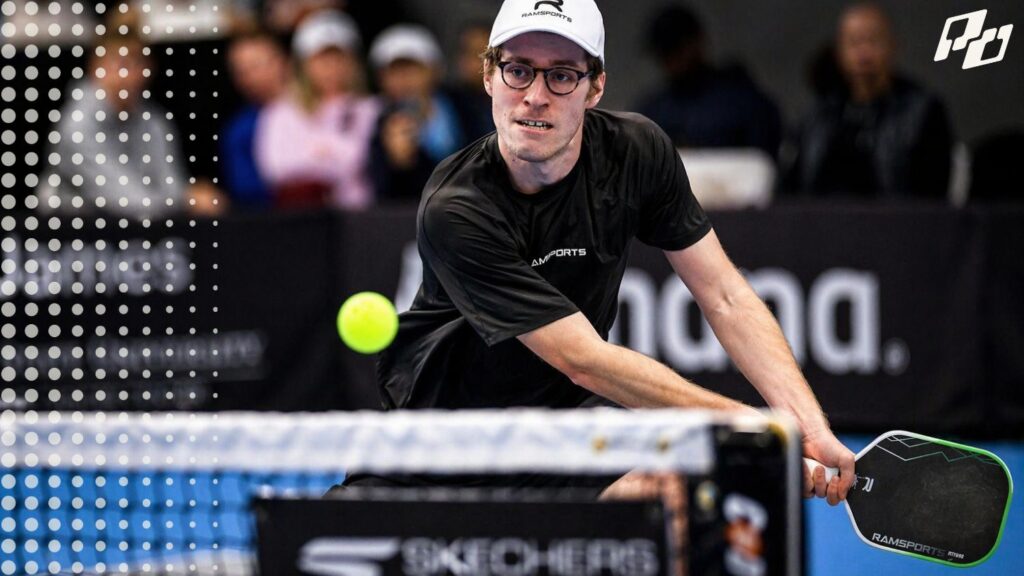
The two-handed backhand down-the-line speed-up is a doubles attack used when an opponent cheats toward the middle. Stay low, contact the ball in front, use a compact swing, aim inside the sideline, and hit with controlled pace and topspin rather than full power.
A two-handed backhand speed-up down the line sounds like one of those “pro player only” shots.
And to be fair, it is not the first shot I’d teach a newer player.
But for early-intermediate and improving doubles players, it can become a really useful weapon — especially if you often play the right side and have a decent two-handed backhand.
The trick is understanding what this shot is actually for. It is not just, “See ball, hit hard.”
The best version of this shot is more like a little trap: you make your opponent think the ball is going crosscourt or middle, then you flip it behind them down the line when they lean too far toward the middle.
That is why this shot works.
Not because it is the hardest ball on the court.
Because it attacks the space your opponent just stopped protecting.
What Is the Two-Handed Backhand Down-the-Line Speed-Up?
In doubles, this usually happens when you are on the right side of the court as a right-handed player and the ball comes to your backhand side near the kitchen.
Instead of dinking crosscourt or sending another ball toward the middle, you use your two-handed backhand to speed the ball up down your sideline, usually toward or behind the opponent in front of you.
The key detail is that this is often hit from your inside-foot area — meaning the ball is not way outside your body like a desperate reach. It is more in that zone where your opponent expects you to play safe to the middle or crosscourt.
That expectation is exactly what makes the down-the-line speed-up dangerous.
Why This Shot Works So Well in Doubles
Most rec doubles players are trained to think about the middle. And honestly, they should be.
Middle balls create confusion. Middle speed-ups reduce angles. Middle attacks are often safer than trying to paint sidelines.
But that creates a weakness.
If the opponent across from you starts leaning middle too much, their outside line can open. This is especially true when they expect your two-handed backhand to go crosscourt or toward the center of the court.
That is where the down-the-line speed-up comes in.
You are basically saying:
“I know you think you’re helping in the middle. Now I’m going behind you.”
At 3.0–3.5, many players do this by accident.
At 3.5–4.0, better players start doing it on purpose.
This Is Not a Full-Power Shot
This may be the biggest mistake rec players make with this one.
They hear “speed-up” and think:
“Crush it.”
Please don’t.
A good down-the-line two-handed backhand speed-up is often more like 70% pace with shape than 100% panic power. The goal is to keep the ball low, controlled, and hard to counter — not to launch a missile into the fence.
Think of it as a fast, shaped ball that stays close to the net and dips.
You want enough pace to surprise them, but not so much that you lose control of the contact point.
A simple cue: fast enough to rush them. Soft enough to control.
That is the sweet spot.
When to Use It
This shot works best when the opponent in front of you is starting to cheat middle.
You will usually notice it after a few rallies. Maybe they are reaching in with their forehand. Maybe they are trying to poach balls that are not really theirs. Maybe every time you show a backhand dink, they start shifting toward the center line.
Good. Let them. That is your setup.
The down-the-line speed-up is best when:
- your opponent is leaning middle
- you have already shown crosscourt or middle dinks
- the ball is high enough to attack without scooping
- you are balanced
- your paddle is in front of your body
- your partner is ready for the next ball
That last one matters.
In doubles, a speed-up is not just your shot. It affects your partner too. If you speed up down the line and your partner is asleep, you may win a few points, but you will also start a few fires.
Pro player Ryan Fu breaks down when to use the two-handed backhand down-the-line speed-up:
When Not to Use It
This is where early-intermediate players need discipline. Do not use this shot just because you are bored of dinking. Do not use it because you finally got a ball on your backhand and want to prove something.
And definitely do not use it when the ball is low, your feet are messy, and your body is falling backward.
Bad times to try it:
- the ball is below net height
- you are stretched wide and off-balance
- your opponent is already sitting on the line
- your paddle face is open and likely to pop it up
- your partner is not ready
- you have missed it three times already and are pretending “the next one will go in”
The better rule is: attack because the setup is right, not because you want the rally to end.
That one sentence will save a lot of rec players.
The Setup: Condition First, Attack Second
The shot becomes much better when you earn it.
If your opponent has no reason to respect your crosscourt dink or middle dink, the down-the-line attack is easier to read. But if you have spent several balls showing the same two-handed backhand setup and sending the ball crosscourt or middle, now they have a pattern in their head.
That is when the line opens.
Try this sequence:
- First, hit a few calm two-handed backhand dinks crosscourt.
- Then send one or two toward the middle.
- Let the opponent start leaning, reaching, or anticipating.
- Then, when the ball sits up enough, hold the same look and flip it down the line.
The magic is not only the shot.
It is the fact that the shot looks like something else until it is too late.
The Contact Point
For this shot, contact point is everything.
You want the ball slightly in front of you, around a comfortable strike zone, and high enough that you are not lifting from underneath it.
If the contact is too far behind you, the ball will drift middle or pop up.
If it is too low, you will scoop it.
If it is too far outside your body, you may lose the ability to direct it cleanly down the line.
A good cue: catch it in front, then send it through the line.
Not around the ball.
Not across your body wildly.
Through the line.
The Footwork: Get Under It
A strong two-handed backhand speed-up starts with the legs. That sounds boring, but it is true.
If you stand tall and try to slap the ball with your hands, you will usually hit it flat, high, or long. You need to get low enough so your paddle can work from underneath and behind the ball, giving you a little topspin and shape.
For right-handed players on the right side, this often means loading through the left leg and staying grounded as you swing.
Think:
- knees bent
- chest stable
- weight balanced
- paddle in front
- legs supporting the swing
A good cue: get low with your legs, not loose with your wrist.
The wrist should not be doing all the work. Your lower body gives the shot control. Your hands finish it.
The Swing Path: Short, Shaped, and Directed
The swing should be compact.
This is not a giant tennis backhand. It is a quick, controlled pickleball speed-up from close range.
The paddle path should move through the ball toward your target. I like the idea of imagining an arrow coming out of your paddle face. If you want the ball to go down the line, that arrow should stay pointed down the line as long as possible.
That helps you avoid the common rec-player mistake of pulling across the body and sending the ball into the middle or wide.
Your swing should feel like:
- compact backswing
- paddle face aimed down the line
- quick acceleration
- slight topspin shape
- natural follow-through
Not huge.
Not rushed.
Not wristy and wild.
Just clean.
Where to Aim
You do not need to hit a perfect sideline winner. Actually, for most rec players, aiming for the literal line is too risky.
Aim for a safer down-the-line lane:
- toward the opponent’s outside hip
- toward their outside foot
- behind their reaching paddle
- low through the sideline window
- slightly inside the line, not on the paint
The best target is often not “winner.” It is awkward contact.
If you can make the opponent reach, jam, or counter from a low contact point, you did your job.
At rec level, that often produces a popup, a block into the net, or a rushed counter your partner can finish.
Why Topspin Matters
A flat speed-up down the line can work, but it is risky.
The ball has less room to clear the net and stay in. That is why a little topspin is so useful. It lets you swing with intent while still helping the ball dip.
You do not need a massive tennis-style roll.
You just need enough shape that the ball does not sail.
Cue: brush and send, don’t slap and hope.
If your ball keeps flying long, you are probably opening the paddle face or swinging too flat. If it keeps going into the net, you may be contacting too low or trying to create too much spin without enough forward path.
The Partner Problem: Tell Them It’s Coming
This is a doubles shot, so let’s talk about your partner.
When you speed up down the line, the most likely next ball may come back fast, often toward the middle or at your partner. That means your partner needs to be ready to counter, block, or clean up the next ball.
If you are practicing this shot with a regular partner, tell them:
“When I get that two-handed backhand look on the right side, I may go line. Be ready for the next ball.”
That one sentence prevents a lot of chaos.
If you play random open play, use the shot more carefully. A surprise speed-up can be great, but if your partner is not ready, you may create a mess instead of an advantage.
The Biggest Mistakes Rec Players Make
Mistake 1: Hitting it too hard
You do not need full power. You need surprise, location, and shape.
Mistake 2: Using it without setting it up
If you never dink crosscourt or middle from the same look, the line attack becomes easier to read.
Mistake 3: Attacking from too low
If the ball is below net height, you are asking for trouble. Reset or dink instead.
Mistake 4: Pulling across the ball
Your paddle needs to travel toward the line, not swipe wildly across your body.
Mistake 5: Forgetting the next shot
A speed-up is not always the finish. Often, it is the start of a faster exchange.
How Often Should You Use It?
Less than you think. This is not a “use every rally” shot. It is a changeup. A trap. A way to keep the opponent honest.
If you use it too much, opponents will sit on it. They will hold their line, keep their paddle ready, and make you pay.
A good starting goal: use it once or twice per game when the setup is clearly there.
That is enough to make opponents respect it without turning you into the person who attacks every backhand like rent is due.